Home
Camera
Articles FOR SALE
Orders
I Buy / Wants Repairs
Books Adapters
Leica M5:
yesterday's
outcast, today's star?
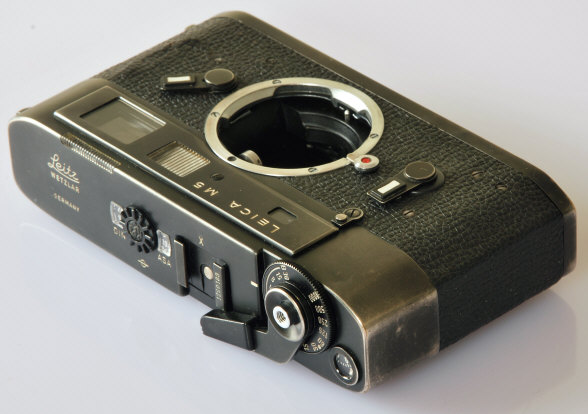
Funny, how time changes things. When
introduced in 1971, the Leica M5 was usually condemned because of its large
size-- despite the fact that the M5 was the first M with TTL metering. I
suspect that if it were introduced today, the size would not be that big an issue.
Beside one of today's top of the line DSLRs, the M5 looks downright small.
Today the M5 is often overlooked as a
serious user, but I think it deserves a lot more attention as a great shooter with notable
features.
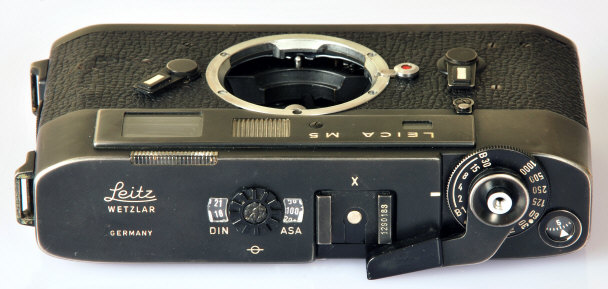
It cannot be over-emphasized what a technological triumph
the M5's TTL metering was in 1971. The M5 was the first
rangefinder with TTL metering, and an excellent metering system it was. SLRs had TTL
metering since the Topcon Super D in 1963. The Nikon SPX
rangefinder prototype from about
1962 had TTL metering, but it never made it to production. For its time the M5's meter was among the most light sensitive made.
Personally, I prefer the feel and ergonomics of the M5 over all other film Leica
M's, including the current production M7 and MP. The M5 appeared in
1971, nineteen years after the M3's introduction. Translation: 19
years of thinking about how to improve the M3. The M5's only weak point
compared to current production is a RF/VF which is not quite as good.
Otherwise, I prefer the ergonomics and camera operation of the M5.
The majority of new Leica buyers -- well off hobbyists -- preferred the feel of
the classic M3 type body. However the shooters -- the guys who made
their living shooting Leicas -- mostly preferred the M5. The proof
of that is the majority of M5's show proportionately far more wear than any
other M camera, except the digital M's which are again extremely popular with
shooters.
-
One of only
five substantially new production Leica
rangefinder designs. Those five are the Leica A, the M3, the M5, the CL,
and most recently the M8. Most Leica rangefinders are modifications of
the A and M3.
-
The last regular production M to be built in the
traditional "adjust and fit" method rather than the later "correct
or replace" method initiated with the M4-2.
-
The last M to be built in Wetzlar
throughout its
production run.
-
The last regular production M to be built without later
cost saving introduced in the M4-2.
-
The only full size M with
shutter speeds visible in the
finder until the M7.
-
The M5 introduced "black" chrome to the camera
world. While heralded as an improvement at the time, in
service black chrome finishes don't wear as well as black paint cameras. Black
paint cameras, even if worn, have a pleasing aesthetic character about them.
Worn black chrome cameras have a tendency to just look worn and dirty (even if they
aren't).
-
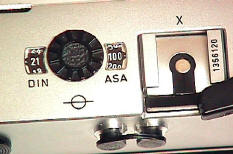
M5 meter operation is simple, but unusual until you get
used to it. 1st set the ASA on the top of the camera (from 6
to 3200). Looking through the finder, you will see the shutter speed visible in the
lower portion of the finder, and to the right of that a horizontal bar. Two meter
needles intersect that bar, one is controlled by the ASA dial and one is controlled by the
light intensity. Adjust shutter speed or f/stop until the three bars
intersect. It sounds more complicated in writing, than it is in
practice. BE CAREFUL not to depress the shutter release while making a meter reading
-- that will start to recess the meter cell which will give you an incorrect reading.
-
For years the last regular production M to have an
engraved Top
plate -- a small thing to some people, a big thing to many
long time Leica users and collectors.
-
Due to the increased use
of plastic in all of the Leica M models that followed, some technicians
regard the M5 as the last of the best quality M bodies.
-
Personally, I prefer the overall shooting experience of the M5 to the later
M6 or current MP.
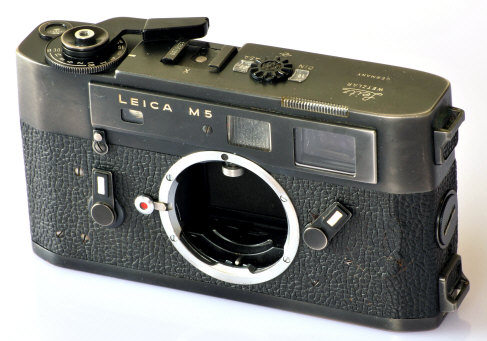
The twin strap lugs
on the same end of the body mean you can carry the body vertically instead of
horizontally. Cool!
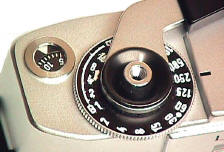
Largest and most convenient M shutter
speed dial, adjustable without taking the camera from your eye. Very
conveniently it overhangs the top plate, making for very comfortable and quick
manipulation. Aesthetically its centering around the advance is also more pleasing
than a separate shutter speed dial, at least to my own eyes.
First M with a hot shoe
M5 has the M4's 35/135, 50, 90
finder, with shutter speeds and meter needles added.
Shutter speeds are from 1/2 to 1/1000th.
Intermediate speeds can set except between
1/30th to 1/60th. 1 second is possible by setting the camera on B and releasing the
shutter with the self timer.
The only full size M to have a spot meter.
The 8mm CDS cell translates to the center
1/3 of your 24mm vertical film plane. According to the 15th edition of the Leica
Manual, which covered the M5 for the first time, this works out roughly equal to the
following areas in the finder with the various lenses: the 50mm frameline with 21m
lenses, the 90mm frameline with 28mm lenses, the 135mm frameline with 35mm lenses, the
four arcs of circle around the rangefinder patch (a unique M5 finder feature, just to
indicate the metering pattern) for 50mm lenses, and the rangefinder focusing patch for 90
and 135mm lenses.
-
The meter is an 8mm circular CDS cell
which raises to the center of the film plane as the shutter is cocked, and
lowers before the first curtain opens. When metering make sure your finger is
not on the shutter release, as that can partially lower the CDS cell and affect your meter
reading. The CDS cell only raises when a lens is mounted, or when you fool it by
mounting a screw mount to bayonet adapter.
-
Batteries: The M5 was designed for 625 mercury batteries which are
now illegal in many countries, including the US. The best solution is
probably the CRIS battery adapter, which adapts the battery compartment to a
modern and easily available silver battery.
-
Battery Check:
Move the frame preview lever to the extreme left, away from the lens. If the battery
is good, one of the viewfinder bars will move into the cutout area on the lower right of
the meter display.
-
Lenses which project deeply into the body
cavity may not give correct metering with the M5, worse, they
may damage the meter cell. The 21/4 Super Angulon and the 21/3.4 below #
2437251 must be modified by Leica before mounting on the M5, otherwise Leica warns of
damage to the meter. Likewise 28/2.8 Elmarits below number 2314921 must be modified
by Leica before mounting on the M5, otherwise Leica warns of damage to the meter.
Likewise collapsible 50 and 90 lenses may be used on the M5, but NOT
collapsed into the body. The Voigtlander 50/2 Heliar is the only
collapsible 50 I know of that can be safely collapsed into the M5.
-
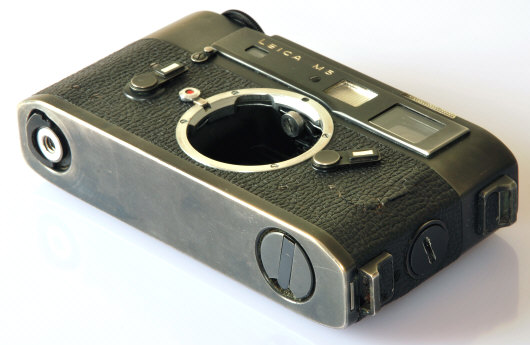
First M with a larger than M3 Body size.
The M8/M9 is also larger than an M3. The M10 aka M240 is the largest
digital M yet. I don't have a M10 to photograph besides a M5,
but the sizes are not that different. While the M5 has a longer body,
the M10 is much thicker and actually feels like a larger camera in my hands.
-
Only M with my favorite
same end twin body strap lugs, allowing
vertical carrying of the camera. This is a GREAT feature!
-
M Seal: M3, M2, and M4 Leicas are famous for the
black "seal" at the 12 o'clock lens mount position. An intact seal is
generally taken to mean that either the camera has never been opened up, or it was opened
and resealed by Leica. Not so the M5. The M5 can easily be serviced without
removing the seal!
-
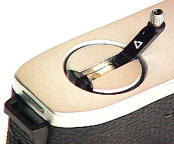
Double Exposures: the M5 is the first M to allow the
photog to reliably make double exposures. As explained in the Leica Manual:
#1 shoot a blank frame with the lens cap ON. #2 take up the
tension on the film cassette by turning the rewind crank you feel tension, leave the
rewind crank in extended position as shown in the pic below #3 Turn the rewind
release lever on the front of the camera downward, and hold it down as you cock the
shutter #4 take the first exposure #5 repeat step # 3 as many times as you
like for multiple exposures. #6 Fold rewind lever and move rewind release lever to
vertical position for normal shooting.
-
Things to Look Out For:
1) If part or all of the viewfinder is blacked
out, it has major problems and will likely need a replacement rangefinder.
Don't buy the camera unless its very cheap for parts.
2)
Separated prisms - focus the rangefinder patch on something white. The
RF images should be clear with no "wiggly" patterns looking similar to dirt
on a dirty window. If you see those patterns, its likely
the prisms need re-cementing. SFAIK Leica does not offer this service,
their solution is a new M5 rangefinder mechanism. However many repair
people can do the job, like Don Goldberg.
Do no confuse this
condition with a few specs of dirt in the RF, which is usually recognizable
as sharp black specs in the RF image which are easily cleanable.
3) Slow speeds are often too slow, indicating a
CLA is in order. Don't let this bother you, as any film Leica older
than 15 years is a likely CLA candidate - if it was not already done
4) Battery Corrosion - this may kill the meter as
replacement battery compartments are hard to find
5) Stripped battery cap threads - you can
probably work around this, but it can be a pain
6) Check both cloth curtains for holes.
Open up the back and remove the lens. Hold the camera towards a window
or light. Advance the shutter to look at one curtain, then release the
shutter
to look at the other curtain. IF you see light leaks, at the
least the curtain needs to be patched. If one curtain needs
replacement, it's a good idea to have your tech replace both at the same
time.
7) Many M5's were very heavily used -- which likely translates to more than
their share of repair problems today
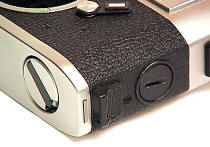
The M5's rewind lever is ratcheted and on the base
plate, both M
firsts. The M5's rewind lever is larger than the other M's, making it larger and
faster to use.
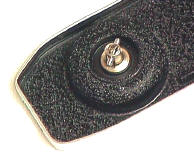
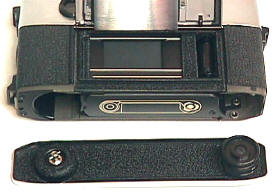
Notice even the interior of the base plate is nicely
finished...something you don't see on later Leicas.
Unfortunately for Leica, the M5 was not a
sales success. New M5's were sitting on dealer's shelves for years after production stopped.
For decades the M5 existed
in relative obscurity as "Leica's failure" -- a title I don't think it really
deserves in terms of its usefulness. As explained on my
CL page, I think a
most of the M5's sales problems had to do with the lower priced and extremely successful
Leica CL. Nevertheless, the M5 took the fall and its excellent body has not
been reintroduced.
The M5 was rediscovered about 1994 by Japanese collectors. Used
prices more than doubled, and maintained there.
Today the M5 offers collectors important historical features, and
shooters important shooting advantages.
Variations:
-
Earlier
M5's have 2 straps lugs only on the end of the body, chrome and black
chrome versions
-
Later
M5's have 3 strap lugs, so the M5 could also be carried horizontally
(not cool), chrome and black versions
-
The
rarest M5's are the black and chrome 50th Anniversary M5's with special 50th
Anniversary engraving
-
Production: Chrome 10,700 and Black 23,150 including special Leica
50th Anniversary (1,550 or 1,750 depending upon source)
-
Note the
M5 was only available in black chrome or silver chrome, unfortunately
M5's never left the factory in black paint.
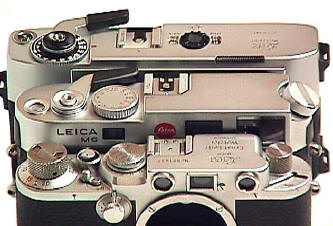
Yesterday's and today's Leicas, the IIIf Red Dial, M6 TTL, and
M5.
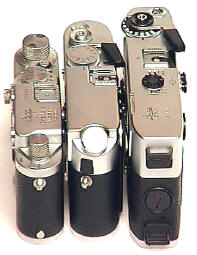
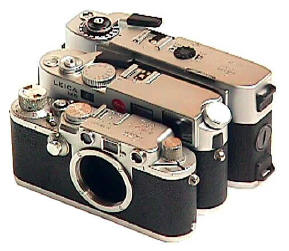
The M5 is roughly the size of the Canon 7s, and much smaller
than today's DSLRs like the Nikon D3.
Instead of reading how
"large" the M5 is in the various Leica books, try it for yourself. You
might be pleasantly surprised by its fit in your hands and its immanently usable features.
Mind Trick! Put it
besides the new M10 aka M240, and the large M5 no longer seems so large!
Revised:
April 22, 2013
. Copyright � 1998-2013
Stephen Gandy. All rights reserved. This means you may NOT
copy and re-use the text or the pictures in ANY other internet or printed
publication of ANY kind. Information in this document is subject to change
without notice. Other products and companies referred to herein are
trademarks or registered trademarks of their respective companies or mark
holders.